Attack on Calais led by a Canadian
The Leader-Post, 22 June 1940 · The Calais raid, June 1940
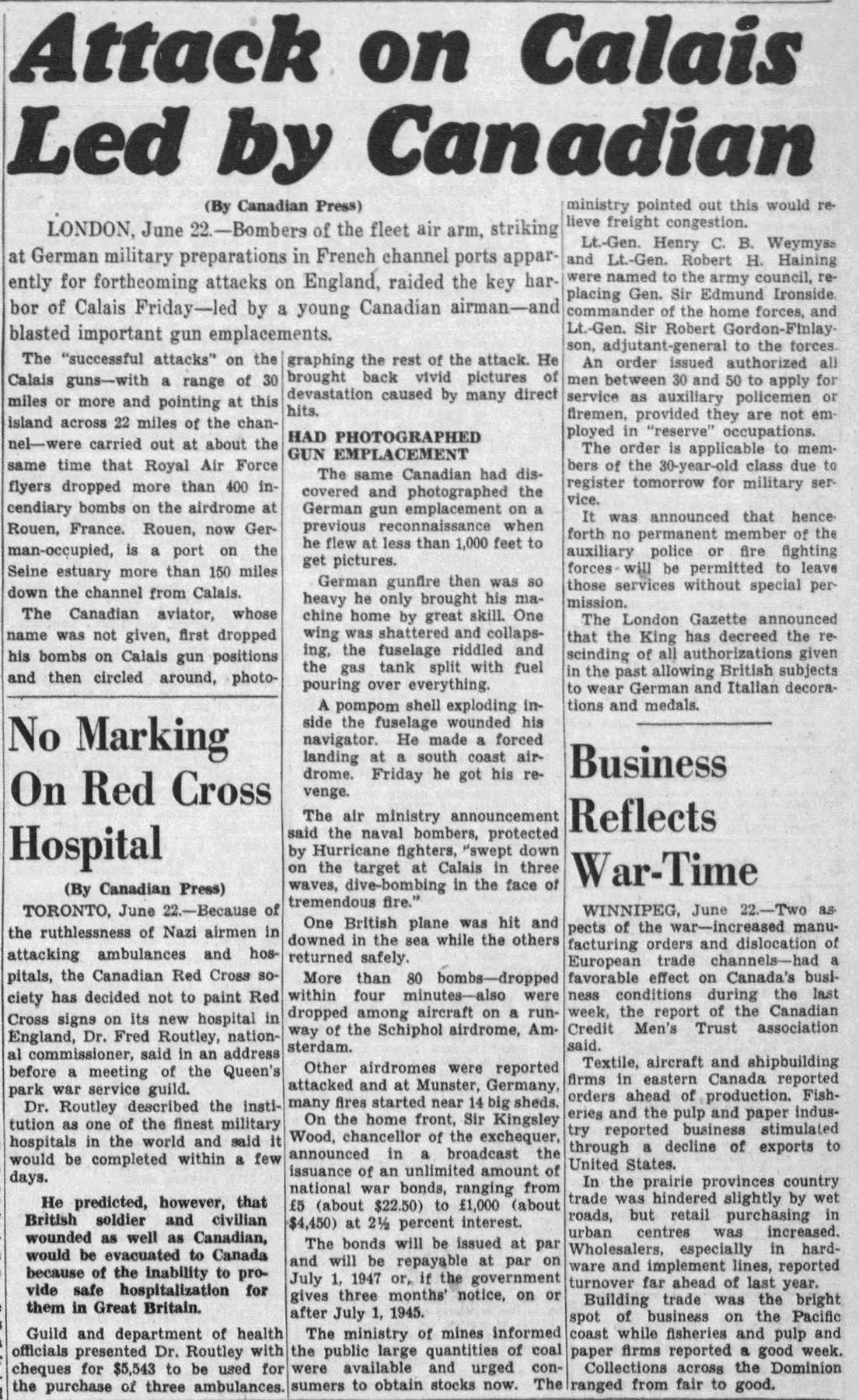
Attack on Calais Led by Canadian
(By Canadian Press)
LONDON, June 22.—Bombers of the fleet air arm, striking at German military preparations in French channel ports apparently for forthcoming attacks on England, raided the key harbor of Calais Friday—led by a young Canadian airman—and blasted important gun emplacements.
The “successful attacks” on the Calais guns—with a range of 30 miles or more and pointing at this island across 22 miles of the channel—were carried out at about the same time that Royal Air Force flyers dropped more than 400 incendiary bombs on the airdrome at Rouen, France. Rouen, now German-occupied, is a port on the Seine estuary more than 150 miles down the channel from Calais.
The Canadian aviator, whose name was not given, first dropped his bombs on Calais gun positions and then circled around, photographing the rest of the attack. He brought back vivid pictures of devastation caused by many direct hits.
HAD PHOTOGRAPHED GUN EMPLACEMENT
The same Canadian had discovered and photographed the German gun emplacement on a previous reconnaissance when he flew at less than 1,000 feet to get pictures.
German gunfire then was so heavy he only brought his machine home by great skill. One wing was shattered and collapsing, the fuselage riddled and the gas tank split with fuel pouring over everything.
A pompom shell exploding inside the fuselage wounded his navigator. He made a forced landing at a south coast airdrome. Friday he got his revenge.
The air ministry announcement said the naval bombers, protected by Hurricane fighters, “swept down on the target at Calais in three waves, dive-bombing in the face of tremendous fire.”
One British plane was hit and downed in the sea while the others returned safely.
More than 80 bombs—dropped within four minutes—also were dropped among aircraft on a runway of the Schiphol airdrome, Amsterdam.
Other airdromes were reported attacked and at Munster, Germany, many fires started near 14 big sheds.
Martyn is not named. Transcription stops after the Munster paragraph. The same London dispatch carries on with unrelated home-front items (war bonds, ministry of mines coal notice, army council appointments, auxiliary police/firemen order, London Gazette), which continue into the next column and are not transcribed. Other articles on the page ('No Marking On Red Cross Hospital', 'Business Reflects War-Time') are also left out. 'HAD PHOTOGRAPHED GUN EMPLACEMENT' is a bold sub-heading, given as its own paragraph. '(By Canadian Press)' is the printed byline.